If it burns when you pee, it’s often a sign of a simple urinary tract infection (UTI) or, in some cases, a kidney infection.
As a GP in urgent care, I often see patients who thought their symptoms would settle on their own. This was until they suddenly became much more unwell and ended up in the hospital, so what do you need to know? I will cover this in the article.
If you have burning urine plus a high fever, vomiting, or deep pain in your side (flank), you may have a kidney infection rather than a simple UTI. Seek medical advice today, as kidney infections require longer antibiotic courses to prevent sepsis
Why a Kidney Infection Feels Like a ‘Whole Body’ Illness vs. a Bladder Infection
Burning, needing to go urgently, and going more often than usual. If you feel well and just have mild symptoms, it’s more likely to be a simple bladder infection.
As a doctor, one of the things I pay attention to is the pattern of the pain. Kidney pain often feels much deeper and sharper than normal muscular back pain.
| Symptom | Simple UTI | Kidney Infection |
|---|---|---|
| Burning urine | ✓ | ✓ |
| Fever | Less common | Common – Red flag |
| Back pain | Less common | Common |
| Vomiting | Less common | Possible |
| Red flag | not present | Shivering episodes – rigors |
Possible kidney infection if…
You have the above symptoms, but you also notice other symptoms like one-sided back pain, fever, vomiting, or rigours. You need to look for clues that your body is fighting a more serious infection, and that you generally feel quite sick.
Go to urgent care / A&E now if…
These are what doctors call red flags — and they mean it’s safest to get checked in hospital. If you feel really unwell, dizzy, shivery, shaky, can’t do your normal activities, can’t walk around properly, or are vomiting, don’t wait.
Pay more attention to urgent symptoms if you are elderly, pregnant, immunocompromised, or have other severe symptoms.
When to Seek Help
In the emergency department where I work, there are so many times when a patient says to me, “I had urinary symptoms, and I thought they would go away. I started drinking a lot of fluids and monitoring my symptoms, but they got worse.”
There are definitely patients with simple urinary symptoms who do get better, but you can’t always predict who they’ll be. You’re more likely to become unwell or have complications if you’re elderly or immunocompromised.
In urgent care, I often see people who assume their symptoms would settle on their own — until they suddenly become much more unwell.
I remember seeing a patient in urgent care called Kate, who initially thought it was “just a simple UTI”. She tried to manage it at home for several days by drinking more and using UTI sachets, but then started developing fever, vomiting, and severe flank pain.
By the time she came in, she looked unwell. She was struggling to walk around properly and needed hospital treatment with IV antibiotics and fluids. That’s why I always tell people not to ignore symptoms if they are getting worse.
What’s the difference between a UTI and a kidney infection?
Lower UTI (bladder/urethra): what’s happening in a lower urinary tract infection
A lower urinary tract infection usually involves the bladder. We call this cystitis. It can also involve the urethra, the tube that carries urine from the bladder.
Kidney infection (pyelonephritis): why it’s more serious
Kidney infections are also called pyelonephritis.
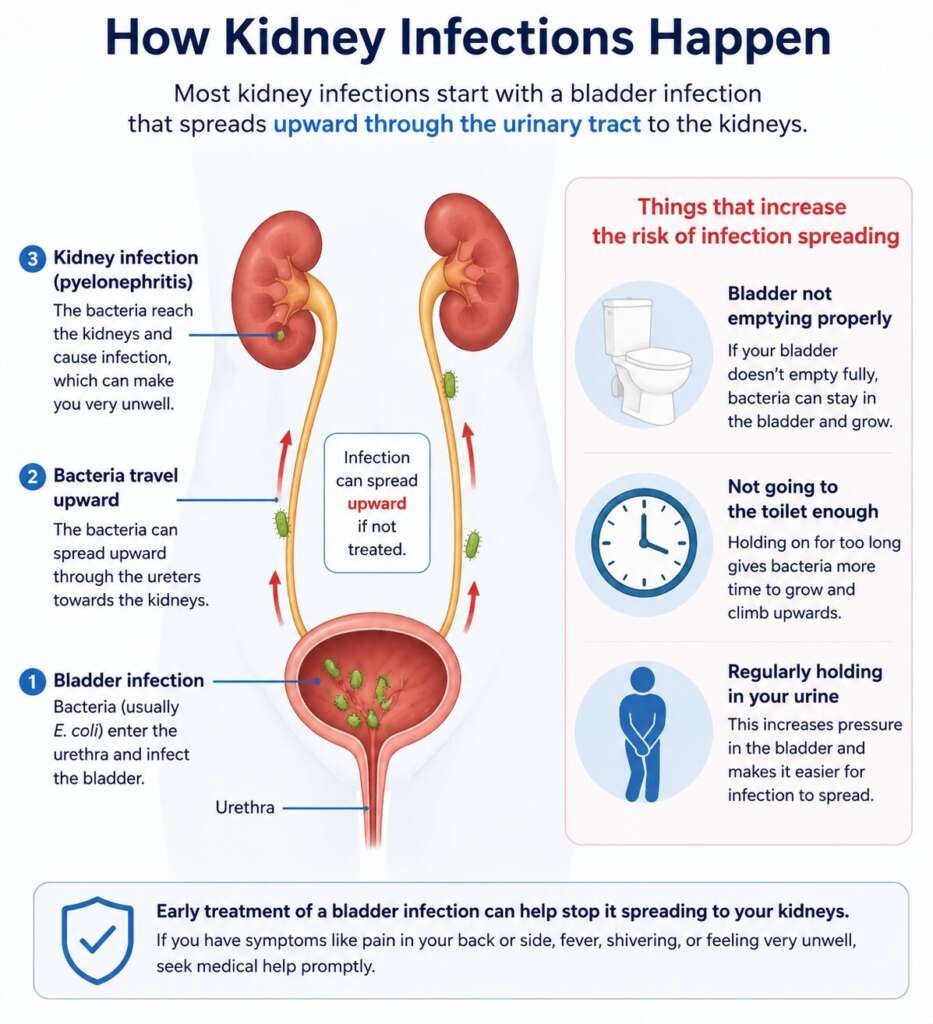
This means the bacteria have travelled up from your bladder to your kidneys — and that’s usually when things get more serious.
The kidneys are much larger organs, and when the infection spreads there, you can become very unwell. You might feel feverish, sick, weak, and exhausted, and doctors take it seriously to prevent further spread.
If left untreated, it can lead to complications such as sepsis, in which the infection spreads into your bloodstream. Sepsis can be life-threatening, which is why worsening urinary symptoms should never be ignored.
Symptoms comparison: UTI vs kidney infection
Common UTI symptoms (lower UTI)
- Burning when you pee
- Needing to go more urgently to the bathroom
- You’re only able to pass all events if you’re in when you do go
- Your urine starts to smell strong and look cloudy
- You notice you have lower tummy pain
Kidney infection symptoms (upper UTI)
- You have all the above symptoms, but you have additional symptoms appearing, like
- Fever
- Shivering
- Start to feel very weak
- Pain in your lower back, right above your hips –> we call this flank pain
- Nausea and sometimes vomiting
Symptoms in women vs men
It’s important to note that urinary tract infections are more common in women than in men. The main reason for this is that men have a much larger urethra, the tube that passes urine out of the body. So the bacteria have to spread all the way up your urethra to infect the bladder, whereas in women, the urethra is much shorter.

Symptoms in older adults, e.g., above 70 (can be more subtle)
In older adults, symptoms might be less obvious. They might start to feel generally unwell, shivering, and shaking. Symptoms include a behaviour change, feeling more confused, not eating and drinking as much, and feeling more unsteady on their feet.
It’s important to get help more quickly for people who are more immunocompromised or elderly, so the infection doesn’t spread.
Kidney infection pain: where it is and what it feels like
Typical pain location (flank, back, side)
It often feels like a dull ache, usually on one side just underneath your ribs.
It tends to feel like a deeper type of pain, unlike muscle pain, which is often more superficial.
Can a kidney infection cause front or abdominal pain?
Yes. People can experience pain in different places, including the lower abdomen. The location of pain is not an exact science, and kidney infections can affect people differently.
Kidney infection vs kidney stone pain pattern (quick comparison)
Kidney stone pain is usually sudden, more severe, comes in waves, and may slowly move towards the groin.
Pain from a kidney infection is often more constant. You may also have symptoms such as fever, shivering, or shaking, which are more suggestive of an infection than of a kidney stone.
Causes: how a UTI becomes a kidney infection
How bacteria reach the kidneys
Most kidney infections start with a bladder infection that spreads upward through the urinary tract to the kidneys.
If your bladder is not emptying properly, you are not going to the toilet enough, or you are regularly holding in your urine, this can increase the risk of infection spreading.
Common bacteria (e.g. E. coli)
Different types of bacteria can cause urinary infections, which is why doctors sometimes send your urine to the lab for testing.
The most common cause is gut bacteria such as E. coli. This bacteria often spreads from the back passage or the anus area towards the bladder.
When STIs can mimic UTI symptoms (urethritis)
Burning when you pass urine is not always a sign of a bladder infection.
If you have had unprotected sex recently, notice discharge from your vagina or penis, or your symptoms are not quite fitting the typical pattern above, it’s important to think about sexually transmitted infections such as chlamydia and gonorrhoea.
These are bacterial infections that can also affect the urethra, causing symptoms similar to a UTI, along with additional symptoms such as discharge.
Who is at higher risk of a kidney infection?
- Pregnancy
Pregnancy can increase the risk of urinary infections and kidney infections because of changes in the urinary tract and how urine drains from the kidneys. - Kidney stones or blockage
Kidney stones or other obstructions in the urinary tract can trap bacteria and increase the risk of infection spreading. - Diabetes or immunosuppression
People with diabetes or weakened immune systems are more at risk of developing more severe infections and complications. - Recurrent UTIs
If you regularly get urinary infections, there is a higher chance that an infection could eventually spread upwards towards the kidneys. - Catheters or recent procedures
Urinary catheters or recent urinary tract procedures can increase the risk of bacteria entering the urinary system.
Diagnosis: what tests doctors use
Urine dip and urine culture
A urine dip is a quick test that looks for signs of infection in your urine.
Sometimes doctors send urine to the lab to culture the bacteria in the sample. This is called a urine culture, and it can provide important clues about which bacteria are causing the infection and which antibiotics are likely to work best.
Blood tests (infection markers)
If a kidney infection is suspected, blood tests may show signs of infection or inflammation.
When imaging is needed (CT or ultrasound)
Scans such as a CT scan or ultrasound can sometimes show kidney stones, blockage, swelling, or inflammation around the kidneys.
What doctors are looking for (sepsis risk, obstruction)
Doctors want to know whether the infection is spreading, where it is located, and whether a kidney stone is causing a blockage.
A stone that becomes stuck can trap bacteria, worsen pain, and increase the risk of a more serious infection.
Treatment: what actually works
Antibiotics for UTI vs antibiotics for kidney infection
Lower urinary tract infections often need a shorter course of antibiotics.
Kidney infections usually need a longer course, often five days or more. A simple bladder infection may only need a short course, sometimes around three days.
The exact antibiotic and duration depend on your age, gender, symptoms, the severity of the infection, and local prescribing guidance.
When you need hospital treatment (IV antibiotics or fluids)
Hospital treatment is more likely if you are vomiting, very unwell, dehydrated, struggling to keep fluids down, or showing signs that the infection is spreading or causing complications.
Pain relief and fever control (safe options)
Paracetamol can help reduce fever and ease pain.
What to expect after starting antibiotics (timeline)
Most people will start to improve within 24 hours. Sometimes it takes 48 hours or longer.
But if you are still unable to keep fluids down, your symptoms are not improving, or you are having shivering or shaking episodes, you need to go back to the emergency department for review.
At-home care (supportive, not a cure)
Fluids: how much and why they help
Drinking fluids helps your body fight the infection, keeps you well hydrated, and reduces the risk of dehydration.
Heat pad and rest
Heat packs can help ease pain and muscle tension around the affected area.
What to avoid (alcohol, dehydration, delaying treatment)
Avoid alcohol when you are unwell because it can make dehydration worse, mask symptoms, and put extra pressure on your kidneys.
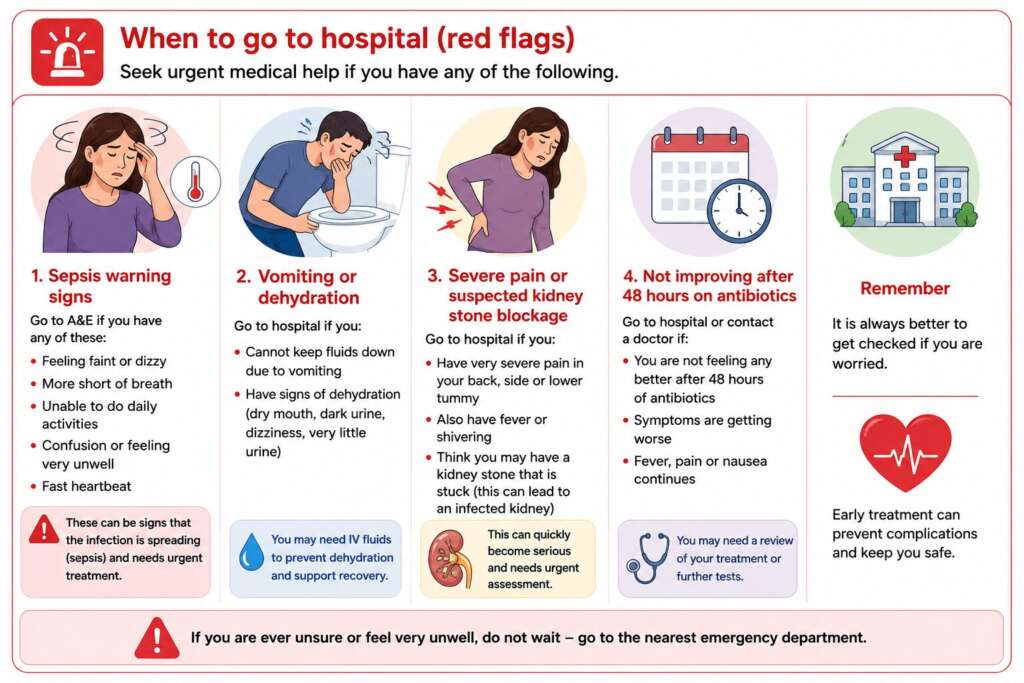
When to go to the hospital (red flags)
Sepsis warning signs
If you are feeling faint, short of breath, unable to do your usual daily activities, or struggling to walk, it is important to go to the emergency department.
Vomiting or dehydration
With both kidney stones and kidney infections, some people may need IV fluids because they are unable to keep fluids down due to vomiting.
Severe pain or suspected kidney stone blockage
If you notice fever and severe pain, this could suggest a kidney infection or a kidney stone causing a blockage.
Not improving after 48 hours on antibiotics.
This is the right time to recheck what is going on and speak to a doctor if your symptoms are still not improving.
FAQs
Can a UTI turn into a kidney infection?
Yes, definitely. Especially if a urine infection is left untreated or urine flow is obstructed due to a kidney stone.
How do I know if back pain is kidney-related?
Look at the pattern of symptoms. If you have lower back pain alongside fever or urinary symptoms, this is more suspicious than back pain alone.
How long does a kidney infection last?
Most infections improve within a couple of days of starting antibiotics. Kidney infections may require 5–7 days, or sometimes longer, of antibiotics, and recovery can take a few weeks in some people.
Can a kidney infection go away without antibiotics?
Simple bladder infections do not always need antibiotics if symptoms are mild and you feel well. Kidney infections usually do need antibiotics.
Can kidney infections cause sepsis?
Yes, and that is why doctors treat kidney infections seriously. If you have a fever, vomiting, and lower back pain, do not ignore it — seek medical help urgently.
Can a kidney infection make you feel exhausted?
Definitely, a lot of people describe feeling wiped out, weak, feverish, and like they can barely get off the sofa. That’s often a clue that this is more than just a simple bladder infection.
Can you have a kidney infection without burning when you pee?
Yes, you can. Some people mainly notice fever, back pain, vomiting, or feeling generally unwell, without obvious urinary symptoms at the start.
What colour is urine during a kidney infection?
Urine can sometimes look cloudy, darker than normal, or smell stronger. Occasionally, people may notice blood in the urine as well.
Can dehydration make a UTI worse?
Yes. If you become dehydrated, your urine becomes more concentrated, and your bladder does not flush bacteria out as effectively.
Should I go to work with a kidney infection?
Most people with a kidney infection feel too unwell to work, especially if they have fever, pain, or vomiting. Your body usually needs proper rest and fluids while recovering.
Can kidney infections come back?
Yes. Some people are more prone to recurrent urinary infections, especially if there is an underlying issue like kidney stones, diabetes, bladder emptying problems, or recurrent UTIs.
When should I worry about a UTI?
You should worry more if you develop fever, shivering, vomiting, lower back pain, confusion, or feel suddenly much more unwell. Those symptoms can suggest the infection is spreading beyond the bladder.
Takeaway (simple)
The one rule to remember
Urinary symptoms plus fever, vomiting, shivering, shaking, or lower back pain should always be treated as possible signs of a kidney infection. Make sure you get same-day medical advice.
Medical references and date
Content up to date: February 2026.
Disclaimer
This article is for general education and is not a substitute for personal medical advice, diagnosis, or treatment. If you are worried, seek medical advice from a qualified healthcare professional.
Medically reviewed by Dr Ann Nainan, GP (UK)
MBBS, MRCGP
GMC: 7406903
Content updated: May 2026